A recent article: Did the Indian capital controls work as a tool for macroeconomic policy, Ila Patnaik and Ajay Shah. IMF Economic Review, page 439--464, volume 60, 2012.
At the main page for this paper, you will find all the materials: a video presentation, PDF paper, link into the journal, a compact summary on voxEU.
Tuesday, 20 November 2012

Friday, 16 November 2012
Growing pains
Indian Express, 16th November 2012
Clarify policy and ease bottlenecks to spur investment
Preventing India's growth slowdown is a difficult but not impossible task. The government needs to follow a two-pronged strategy to put India back on a high-growth path. On the one hand, it must focus on putting stalled projects back on track. On the other hand, it must put in place policy frameworks for the allocation of land and natural resources, as well as for environmental standards and the rule of law.
Episodes like the 2G spectrum sale and the coal block allocation issue demonstrate that the lack of a clear framework can seriously disrupt investment and growth. Though there are no easy answers to these questions, arriving at policy frameworks through research, public consultation and discussions among stakeholders, and implementing the rule of law, should make them more tractable than they are today.
One somewhat simple way to address growth slowdown in the short run may be through fiscal and monetary policies. But in India, macroeconomic policy choices, even in the short run, are going to be very difficult. The latest data on output and prices confirm the stagflation that has been on its way. We now see growth slipping below 5 per cent, even as consumer price inflation reaches 9.75 per cent. This is almost the reverse combination of what India witnessed a few years ago at the peak of the business cycle.
As output growth slipped in September 2012, with the IIP data showing an actual contraction in economic activity, consumer price inflation continued to rise, hitting almost double digits. The trade data released also showed a higher trade deficit. Stagflation is a much more difficult problem than overheating, which happens when prices and output are both rising, and which we saw in 2006 and 2007. That is when fiscal and monetary policy both need to be contractionary. Tackling stagflation is also more difficult than facing a recession, when fiscal and monetary policies both need to be expansionary. When faced with stagflation, no standard recipes work. Contractionary fiscal policy would mean raising tax rates, something that would hurt investment further. Easing monetary policy would mean cutting interest rates, something that would make inflation worse. The experience of other countries like the US, which has seen stagflation in the past, suggests that simple solutions can only worsen economic conditions.
Standard macroeconomic stabilisation policies are not the answer to India's economic problems today. One clear area of failure, which needs government action, is governance issues. These are responsible for having created an environment that has put on hold various projects and discouraged further investment. The stalling of a large number of investment projects since governance problems began, especially after 2010, have reduced investment and worsened supply constraints, particularly in infrastructure. Various bottlenecks, especially bureaucratic and judicial, are now holding back the economy as never before. The tools of macroeconomic policy are meant to address an economy operating around its full capacity output. That framework assumes that problems such as India's do not exist. India is not at its long-run, steady-state growth rate. The output gap is not caused by investment inventory cycles, which can be addressed by macro policies.
To address immediate governance issues, the government has proposed a National Investment Board (NIB) to speed up stalled projects. This could help push up output as well as bring down prices. But the environment minister, Jayanthi Natarajan, has opposed routing environmental clearances through the NIB. This brings us to the question of how the NIB will work. Can the bulk of issues on which investment is stalled be resolved without transparent policy frameworks in place?
There is no doubt that the reforms proposed by Finance Minister P. Chidambaram created optimism among investors, both foreign and domestic. But while it is true that the gloom and doom went away, it was replaced only by a very cautious optimism. Investors need to see the government take concrete steps before making investment decisions. If large projects and large sums of money continue to be stuck in governmental processes, and investment decisions keep getting postponed, it will not encourage them to invest. Not only are resources limited, an increasing number of bad assets reduces the banks' ability to lend. It is not just that companies are constrained by their capacity to incur further risk, there is a trust and governance deficit. Equally important are the worsening finances of the banking sector. The government needs to act quickly.
But if the laws that create a policy framework are not in place, there are fears that the very clearances that such a board gives could be challenged in court the very next day. Therefore, the second element of the strategy is to understand why projects were stalled and to correct the existing policy frameworks.
There will be no simple answers. In the process of economic growth, there are trade-offs between protecting the environment, forests and land rights on the one hand, and creating infrastructure, generating power, making dams, encouraging mining and other economic activity on the other. Any solution that swings to one extreme will not work. It will be very easy to stall projects if citizens who are losers in the process, or those that support them, go to court or use political pressure to stop economic activity. Any attempt to push through projects in a non-transparent or arbitrary way will not be acceptable either. There is no doubt that India will have to industrialise, but in such a way that the environment and forests are protected. It is essential to put in place the rule of law and processes to ensure that such issues do not hijack politics and economics.
Most countries face similar problems when they grow fast. As the Indian economy has grown, the stakes involved have become very high. With that, corruption in high places has become more attractive. What must be a priority is the creation of policy frameworks, for example, strategies for the sale of natural resources or public sector enterprises, through auction or otherwise, should be formulated in a transparent, consultative process, with independent research and discussions with stakeholders, where the public understands the debate and buys into the solutions.
Thursday, 15 November 2012
NIPFP study finds large returns from Aadhaar project

This study is significant in the light of the current debates on how to reduce the subsidy bill.
The study finds that substantial benefits would accrue to the government by integrating Aadhaar with schemes such as PDS, MNREGS, fertiliser and LPG subsidies, as well as certain housing, education and health programmes. Even after taking all costs into account, and making modest assumptions about leakages, of about 7-12 percent of the value of the transfer/subsidy, the study finds that the Aadhaar project would yield an internal rate of return of 52.85 percent to the government.
Integrating Aadhaar with government welfare schemes will improve identification and authentication. Hence, the leakages due to duplicates and 'ghost beneficiaries' can be tackled. Plausible estimates about such leakages are available mainly for MNREGS and PDS programmes in government reports and the academic literature. Using these estimates as benchmarks, for the components of the leakages that Aadhaar can directly address, the NIPFP study extends the analysis to include other government schemes where transfer to beneficiaries takes place. A reduction in leakages is considered a benefit to the government since the funds can be saved and used for other purposes.
For the PDS, the benefit accruing due to integration with Aadhaar is assumed to be in terms of reduction in leakages in the delivery of foodgrains (rice and wheat) and kerosene. For MNREGS, using the wage expenditure data and several social audit reports, the reduction in leakage in wage payments through muster automation and disbursement through Aadhaar-enabled bank accounts has been estimated. For fertilisers and LPG distribution, the diversion is estimated as a percentage of the government subsidy, which is assumed to be getting leaked or diverted for purposes beyond the subsidy's rationale. For other schemes, which include the Indira Awaas Yojana, Janani Suraksha Yojana, various pension schemes, scholarships, and payments made to workers under NRHM and ICDS, the leakages due to identfication errors are estimated as a percentage of the value of the transfer payment.
The costs of developing and maintaining Aadhaar, as well as integrating Aadhaar with the government schemes is computed in the study.
Thus, comparing the benefits with the costs, the NIPFP study concludes that the internal rate of return in real terms of the Aadhaar project is 52.85 percent. This analysis shows that even with modest assumptions on benefits, the Aadhaar project yields a high internal rate of return to the government.
The NIPFP study focuses on certain tangible benefits accruing to the government, and therefore does not count the benefits to the economy and the intangible benefits to the government and society. Many benefits of the program are intangible and therefore difficult to quantify. For example, by making every individual identifiable, existing government welfare schemes can become more demand-led. Beneficiaries are better empowered to hold the government accountable for their rights and entitlements, thus influencing the way these schemes can be designed and implemented. Also, with digitised, non-local information on workers seeking jobs, labour mobility and migration experience will become easier.
The study argues that if we were to add more programs and expand the scope of the analysis, and consider the intangible benefits, it is likely that the returns will be higher.
Full details of the calculations have been released on the NIPFP website. Other scholars and policy analysts can modify some assumptions and explore alternative outcomes.
Wednesday, 7 November 2012
NIPFP Macro-DSGE Workshop, 2012
Organised by:
Macro/Finance Group
Conference Program
Date: November 12, 2012
Time: 09:30 A.M.
Venue: Conference Hall, Ground Floor, New Building
National Institute of Public Finance and Policy,
18/2 Satsang Vihar Marg, Special Institutional Area,
New Delhi - 110067
View Larger Map
Conference Program
Date: November 12, 2012
Time: 09:30 A.M.
Venue: Conference Hall, Ground Floor, New Building
National Institute of Public Finance and Policy,
18/2 Satsang Vihar Marg, Special Institutional Area,
New Delhi - 110067
View Larger Map
Governance 2.0
Indian Express, 7th November 2012
The idea of economic reform in India has largely been seen as the reduction of restrictions imposed by the government on economic activity - it must go beyond this narrow scope. The next wave of reforms needs to focus on governance. The lack of transparency in the government's functioning at present is increasingly unacceptable.
In its recent approach paper, the Financial Sector Legislative Reform Commission (FSLRC) outlined recommendations to bring about an improvement in governance, with a focus on financial sector regulation. These proposals hold lessons for the ways in which the government functions in other sectors as well.
Many government tasks can be outsourced to external agencies. This is motivated by two considerations: political independence and functional autonomy. The Election Commission should not care about pleasing the ruling party, so it should be politically independent. Tax administration should not be used by the ruling party to harass rivals and obtain election funding. Thus, tax administration should be politically independent. In finance, functions such as regulation and supervision should be immune to political pressure, much like tax administration should be distanced from politics. In addition, monetary policy should not be influenced by or subject to election cycles, which makes a case for the political independence of the RBI.
The second kind of autonomy is functional. This is rooted in problems that arise from the outdated ways in which the Indian government operates. It is difficult to construct competent and professional structures within the government, given the weaknesses of human resource processes, cumbersome procurement policies, etc. If bodies external to the government are freed from the strictures that depress its productivity, superior outcomes can be attained. Bodies outside the government can aspire to the professionalism, specialised staff capability and efficiency of the private sector once they are free to deviate from government processes.
These two reasons make a compelling case for political independence and functional autonomy in many situations. But we have to be mindful about accountability. When power is given to unelected officials working in agencies external to the government, what is the mechanism by which accountability can be ensured? Why will these officials pursue the public interest? Will they not, instead, pursue their own interests? In recent decades, we have watched agencies external to the government fail to cater to the interests of the people. They tend to do things that are convenient for existing officials, reduce the work of the agency and increase discretionary power. They also avoid taking responsibility.
It is important to consider the independence of these agencies, but it is essential that questions of accountability also be included in the discussion. A government agency is only well structured when it has the right blend of independence and accountability. Enshrining independence mechanisms in the law must go along with enshrining accountability mechanisms in the law.
The FSLRC has laid out four paths to accountability. The first is clarity of purpose. Poorly specified goals give officials a free hand to pursue their pet projects. So, laws must set down specific objectives and powers.
These goals must not be internally contradictory. For example, the Insurance Regulatory and Development Authority was given the job of regulating insurance companies and of developing the market for insurance. When it supported the unhealthy sales practices of insurance companies with the sale of unit-linked insurance plans, it could claim that it was sacrificing the regulation objective in favour of the development objective. The RBI is able to argue that it failed on inflation control because it has been holding interest rates low in order to pursue other goals, such as preventing exchange rate fluctuations, obtaining low-cost financing for public debt, preventing banks from failing, etc. Each department or agency must have clarity of purpose and not suffer from inherent conflicts of interest.
The second area of concern is the rule-making process. Parliament delegates the writing of rules to regulators, an enormously powerful tool to hand unelected officials. While it is valuable to have officials with professional expertise, we should be mindful of the extent to which unelected officials can pursue their own interests. Hence, the delegation of rule-making powers must be accompanied by an elaborate array of checks and balances in the rule-making process. Regulators must be made to demonstrate that the gains to society from a proposed rule exceed the costs of complying with restrictions. Draft rules must be released to the public and specific responses must be released for every comment. There should be convenient forums for appeal, where rules are subject to judicial scrutiny.
The third area of concern is the rule of law. India's economic policy today has seen numerous failures in that respect, partly due to the socialist policies of the past. There is a need to strip regulatory agencies of arbitrary power. Laws should be known before an action is taken; laws should be applied uniformly; when a law is invoked, it should be accompanied by the rationale employed for its use; and specialised courts for appeal should be available.
The fourth element of accountability is reporting. Once an agency has been properly structured and its objectives have been clearly defined, it should be asked to report on the extent to which it has met these objectives and how it will do better in the future. For instance, a government agency set up for the specialised purpose of addressing consumer complaints in finance must document the case backlog and the extent to which its orders were upheld on appeal, survey evidence about the satisfaction of citizens who filed a complaint, and report the cost of the process as seen by individuals, the compliance cost imposed on firms, etc. Annual reports today are filled with general platitudes about the economy, and reporting must shift away from that to include specific outcomes that the agency was mandated to achieve.
This approach to improved governance emphasises transparency, consultation and rule of law. The application of this approach in the financial sector and beyond will lay the foundation for improved public administration in India.
Thursday, 25 October 2012
Policy easing won't lift investment
Financial Express, 24th October 2012
India is facing the prospect of stagflation. Output growth has slowed down sharply, and is below the recent long-run average of around 7% and consumer price inflation seems to be stuck at around 9-10% (see graphs).

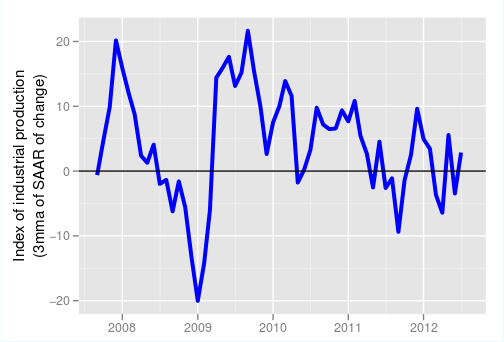

What should RBI's stance be in the forthcoming monetary policy meeting? Under the current circumstances, perhaps the best contribution RBI can make to India's long-term growth is not to give in to the pressure for cutting interest rates, and steadfastly hang in there till inflationary expectations come down. This may happen a few quarters after consumer price inflation rates actually come down. If it moves now, this may not happen.
There is an increasing clamour for RBI to cut interest rates. The government has announced a series of reform measures as well as steps to cut the fiscal deficit such as cutting subsidies on diesel and LPG. Additional plans for disinvestment have been announced. With these and better tax administration, the government hopes to reduce the fiscal deficit. RBI has been making the case that the government needs to bring the fiscal deficit under control for inflation to come down. With the present expansionary fiscal policy, RBI would need to keep monetary policy tight to keep inflation under control. The government is now suggesting that it is doing its bit to control the deficit, so RBI must now ease monetary policy to kick-start investment and push up growth.
RBI Governor Subbarao has a difficult call to make. Considering that inflation has remained high and above RBI's target rate of 4-5% for multiple years now, inflationary expectations have remained high. An easing of monetary policy at this stage will convey that a higher inflation rate is acceptable. This will keep inflation rates high as price setting, salary negotiations and contracts for the coming year will build in the higher inflation rate.
The biggest problem with the investment rate today is issues of government policy and implementation. Projects are stalled largely due to environment and forest clearances, availability of ores and minerals, which has become difficult due to mining bans or other processes that are under litigation or investigation, the difficulties of land acquisition, and the availability of power and water. The government is now setting up a National Investment Board that is expected to give clearances to all projects that cost R1,000 crore or more. Only when projects that are currently stalled due to these problems, bank loans that are being restructured due to these delays and investor sentiment that has been dampened due to the inability of investors to complete their projects on time, start moving ahead, will the private sector have the appetite to take any further risks.

While interest cost is obviously a component of any project, even if interest cost were zero, until the risk of putting equity money into projects can be justified by an expected positive return, many investors are not going to invest more money. Since projects do not run fully on loans, and the risks today posed by the governance problems are so serious, cutting rates will do little to ramp up investment.
In most public debates, there is rarely a lobby for raising interest rates. In general, industry lobbies who talk to media persons, investment advisors and equity market analysts almost always argue the case for rate cuts. They stand to gain from rate cuts and the loud clamour created by them ignores the potential negative impact of the policies they are arguing in favour of. In this case, interest rates are the price being paid by some to others. So there are two sides to the story. Those who lend, i.e the savers, are also impacted by rate cuts. The household savings rate has dropped sharply in one year from 25.4% of GDP in 2010-11 to 22.8% of GDP in 2011-12. Such a sharp and sudden fall in household savings should be a matter of concern. Where did this decline come from and why did it happen? What would be the impact of an interest rate cut on household savings?
This decline in household savings of 2.6% of GDP has come mainly from a sudden and sharp decline in household financial savings. In 2010-11, household financial savings stood at 12.9% of GDP, while in the following year they fell by 2.9% to 10% of GDP. Why did this happen?

The year 2011-12 saw a decline in the growth of bank deposits and small savings. Households prefer to save in real estate and gold. Physical savings of households continued to be high, and even rose slightly, from 12.4% of GDP in 2010-11 to 12.8% of GDP in 2011-12. The bulk of the increase in savings seem to have gone to gold. Last year, gold imports rose dramatically. After the hike in the tariff on gold in the budget, official imports of gold have fallen. Stories from travellers suggest that customs officials in Mumbai are actively trying to prevent gold smuggling in recent months.
World commodity prices are expected to remain depressed as the world economy remains sluggish. The rupee appreciation in recent months has helped reduce the costs of tradables. The slowdown in domestic demand will help stabilise domestic prices. When fiscal policy measures actually have an effect and the deficit comes down, the domestic pressure on prices will reduce. RBI should be in no hurry to ease monetary policy as it can do more harm than good.
Tuesday, 16 October 2012
One head is better than many
Indian Express, 16th Oct 2012
A single financial regulator, rather than sectoral ones, is what India needs
The Union cabinet recently approved two bills expanding the powers of relatively small financial sector regulators. The PFRDA bill and the FCRA Amendment bill, if passed by Parliament, would give statutory powers and greater teeth to the pensions regulator and the commodity futures regulator. Though this may appear to be a reformist move in the current context, it could create difficulties for longer term financial sector regulatory reform.
These two bills were first proposed before the government set up a slew of expert groups to examine financial regulation in India. Almost all these committees suggested that all non-banking financial regulation, at least, be brought under a single regulator. They argued from Indian and international experience that it is becoming increasingly difficult to effectively regulate modern financial firms through a sectoral approach.
It seems unlikely that the cabinet is turning down these expert recommendations, including those from a group chaired by its present chief economic advisor, Raghuram Rajan. It is more likely that in its attempt to fast-track reforms, it has approved all the financial sector and economy bills that had been placed in limbo, without re-examining them carefully in this post-global-crisis world.
The expert groups, including the Mistry, Rajan, Aziz and Sinha committees, have examined the role and function of various regulators and suggested that they be modified to remove the various conflicts of interest, regulatory overlaps and gaps that plague the system today. They also raise questions about economies of scale in the regulation of organised financial trading. At present, regulatory functions on organised financial trading are spread across SEBI, RBI and the Forward Markets Commission (FMC). This separation between multiple regulators has forced an inefficient partitioning within private firms too: for example, a brokerage firm operating on the stock market where it faces SEBI regulation is forced to create a separate subsidiary to trade on commodity futures markets with FMC regulation and a separate subsidiary to be a primary dealer, which involves an engagement with the RBI.
Given the nature of organised financial trading, there could be economies of scale and scope for both government and the private sector through unification of regulation of organised financial trading. This requires pulling together the functions related to the bond and currency market from the RBI, functions related to the stock market from SEBI and functions related to commodity futures markets from the FMC, and merging these into a single agency.
Further, the Indian financial system has changed from one almost entirely dominated by public sector firms to an incipient role for private and foreign firms, which has helped bring a substantial rise in the sophistication of the firms. This has given rise to large, complex financial institutions such as the ICICI and HDFC, which serve households and firms across all aspects of financial services. At the same time, these firms have chosen to organise themselves through a large number of sectoral financial firms, each of which fits the requirements of one financial regulator. But no single sectoral regulator gets a full picture of the risks in such large conglomerates.
The recent cabinet approvals may have consequences similar to the RBI Amendment Act of 2006, which established the RBI as a regulator of the bond market and the currency market. This was a step in the wrong direction, given India's reform agenda on the regulation and supervision of securities markets. In all the OECD countries but one, a single government agency - the securities regulator or the unified financial regulator - deals with all aspects of organised financial trading. In the US, the treatment of organised financial trading is split between the CFTC, which deals with all derivatives, and the SEC, which deals with the spot market. Apart from this, the OECD practice involves a single agency that regulates all organised financial trading, with a unified treatment of equities, commodity futures, interest rate, currencies, corporate bonds and derivatives.
This mistake led to serious consequences for the bond market. In the equity market, the strategy for critical financial infrastructure, exchanges, clearing corporations and depositories, was based on three principles. First, there was a three-way separation between shareholders, the management team and the member financial firms. Second, there was a competitive framework. Third, the regulator, SEBI, did not own critical financial infrastructure.
None of these three principles was applied to the bond market. The critical bond market infrastructure involved a depository (the SGL) and an exchange (NDS) both owned and operated by the RBI. This was a problematic arrangement because the RBI had conflicts of interest by virtue of being an owner and service provider, and at the same time, the regulator (after the enactment of the RBI Amendment Act of 2006). There was a loss of competitive dynamism when the RBI's policy decisions leaned in favour of blocking competition against NDS and SGL. Only financial firms regulated by the RBI, the banks and the primary dealers were allowed to tap into this infrastructure. This framework was thus unable achieve bond market liquidity. On paper, India has an impressive bond market with trading screens, a clearing corporation, etc. But the essence of a market is liquidity, speculative views, and the resilience of liquidity. None of these is found in the Indian bond market.
The Indian discussion on the role and function of government agencies in financial regulation needs to be examined in the context of the difficulties of staffing high quality agencies. Even when an agency starts with a clean slate, without institutional baggage from a pre-reforms India, without conflicts of interest and archiac legal foundations, without expert staff, there is still a substantial risk of failure in institution building.
In India, there are many delays in processing legislations. At every stage, the government should be checking back whether it still want to propose a certain legislation. A little more thought in 2005 would have prevented the RBI Amendment Act of 2006, and a little more thought today will prevent mistakes on FMC and PFRDA. The government already has the benefit of the views and recommendations of various expert committees, which have studied the issue in detail and set the direction of long-term financial sector reform. Government policies policies in the short run should fit with its long term goals.
Subscribe to:
Posts (Atom)